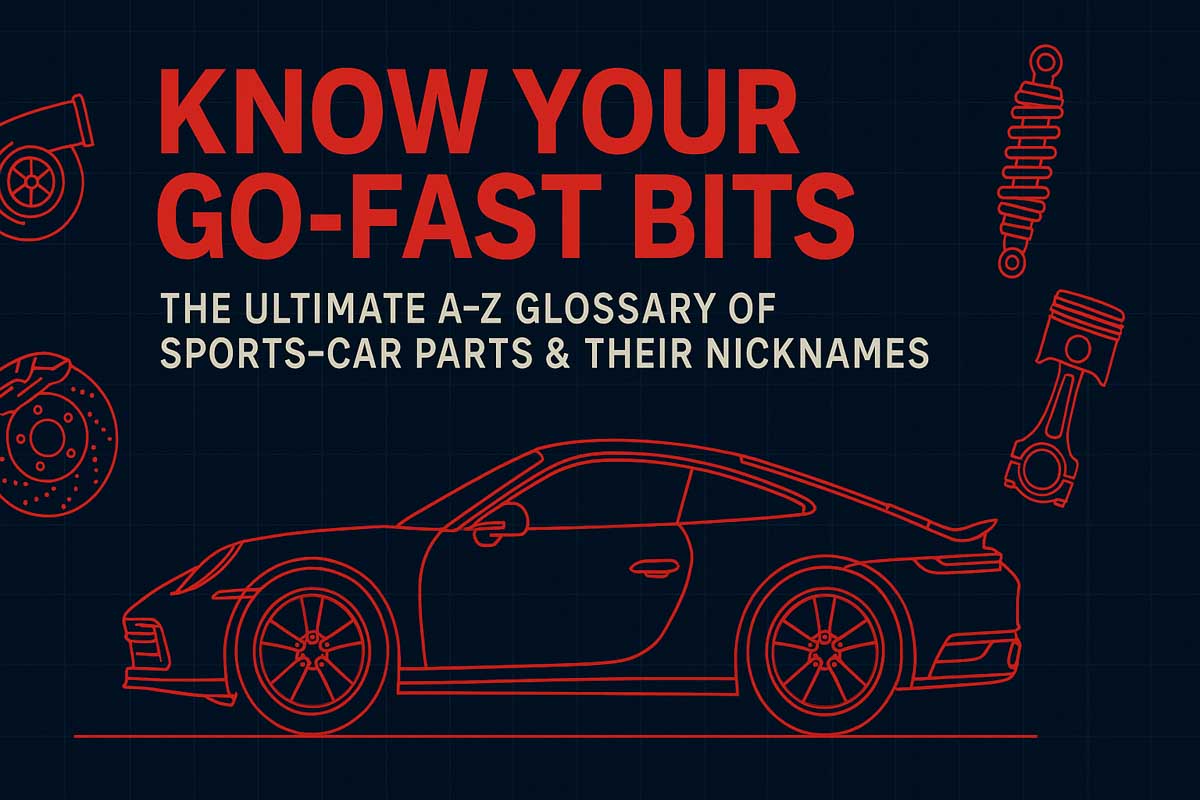
You speak car? Learning the lexicon of sports car parts is no small feat. Here's your cheat sheet. The glossary below is the Rosetta stone for deciphering garage slang, catalog terminology, and pit-lane shorthand.
Engine & Intake / Exhaust
Air intake system -- Ducting that channels outside air to the throttle body. A "cold-air intake" routes the inlet away from engine heat for denser, cooler air.
Camshaft -- A rotating shaft with lobes that open and close the engine's intake and exhaust valves. Aftermarket cams with more aggressive profiles can improve power at the expense of idle quality.
Catalytic converter (cat) -- Emissions device in the exhaust stream that converts harmful gases into less harmful ones. High-flow cats reduce restriction while maintaining emissions compliance.
Throttle body -- The valve controlling airflow into the intake manifold. Larger throttle bodies improve airflow at high RPM.
Turbocharger (turbo) -- An exhaust-driven compressor that forces extra air into the engine, allowing more fuel to be burned and more power to be produced.
Supercharger -- A belt-driven compressor that pressurizes intake air. Unlike a turbocharger, it provides boost immediately without lag.
Intercooler -- A heat exchanger that cools compressed air from a turbo or supercharger before it enters the engine, increasing density and reducing knock risk.
Header -- A performance exhaust manifold with individual tubes for each cylinder that merge into a collector, improving exhaust scavenging.
Transmission & Drivetrain
Clutch -- The friction disc and pressure plate assembly that connects (or disconnects) the engine from the transmission.
Differential (diff) -- A gearset splitting torque left/right between driven wheels. Variations include open, limited-slip (LSD), and locking differentials.
Limited-slip differential (LSD) -- A diff that allows some speed difference between wheels while still transferring torque to the slower wheel, improving traction under power.
Driveshaft (prop shaft) -- The rotating shaft that transmits torque from the transmission to the differential in rear- or all-wheel-drive cars.
Sequential gearbox -- A transmission where gears are selected in order (up or down) without a traditional H-pattern, common in race cars.
Suspension
Coilover -- An integrated coil spring and adjustable damper assembly that allows ride height and spring rate adjustment.
Anti-roll bar (sway bar, ARB) -- A torsional spring connecting left and right suspension that resists body roll in corners.
MacPherson strut -- A common front suspension design combining a shock absorber and spring into a single unit that also serves as the upper pivot point.
Leaf spring -- A flat spring arrangement, common on trucks and older performance cars.
Wheel bearing -- The bearing assembly that allows the wheel hub to rotate on the spindle.
Camber -- The inward or outward tilt of the tire when viewed from the front. Negative camber (tops tilted in) improves cornering grip.
Toe -- The direction wheels point relative to straight ahead. Toe-in improves stability; toe-out improves turn-in response.
Steering
Rack and pinion -- The most common passenger car steering mechanism: a pinion gear on the steering shaft meshes with a rack to translate rotation into lateral movement.
Tie rod -- The link connecting the steering rack to the wheel knuckle.
Steering knuckle -- The pivot assembly that the wheel hub attaches to and that the tie rod steers.
Braking
Caliper -- The hydraulic clamp that squeezes brake pads against the rotor. Fixed calipers with multiple pistons offer more even pad wear and better feel.
Brake pad -- The friction material pressed against the rotor to slow the car. Performance pads handle heat better but may require warm-up before full effectiveness.
Rotor (disc) -- The rotating disc that the caliper clamps onto. Slotted and drilled rotors improve heat dissipation and pad degassing.
Brake bias -- The front/rear split of braking force, adjustable on race cars to optimize stability and avoid lockup.
Electrical / Electronic
ECU (engine control unit) -- The computer that manages fuel injection, ignition timing, and other engine parameters. Aftermarket ECUs or tunes allow custom maps.
Alternator -- The generator that charges the battery and powers electrical systems while the engine runs.
Ignition coil -- Converts low-voltage battery current to the high voltage needed to fire the spark plugs.
Body & Chassis
Subframe -- A secondary frame attached to the main chassis that carries suspension and/or drivetrain components, isolating vibration and simplifying assembly.
Unibody -- A construction method where the body and chassis are integrated into a single structure, as opposed to a body-on-frame design.
Roll cage -- A framework of steel tubes inside the cabin that protects occupants in a rollover and stiffens the chassis torsionally.